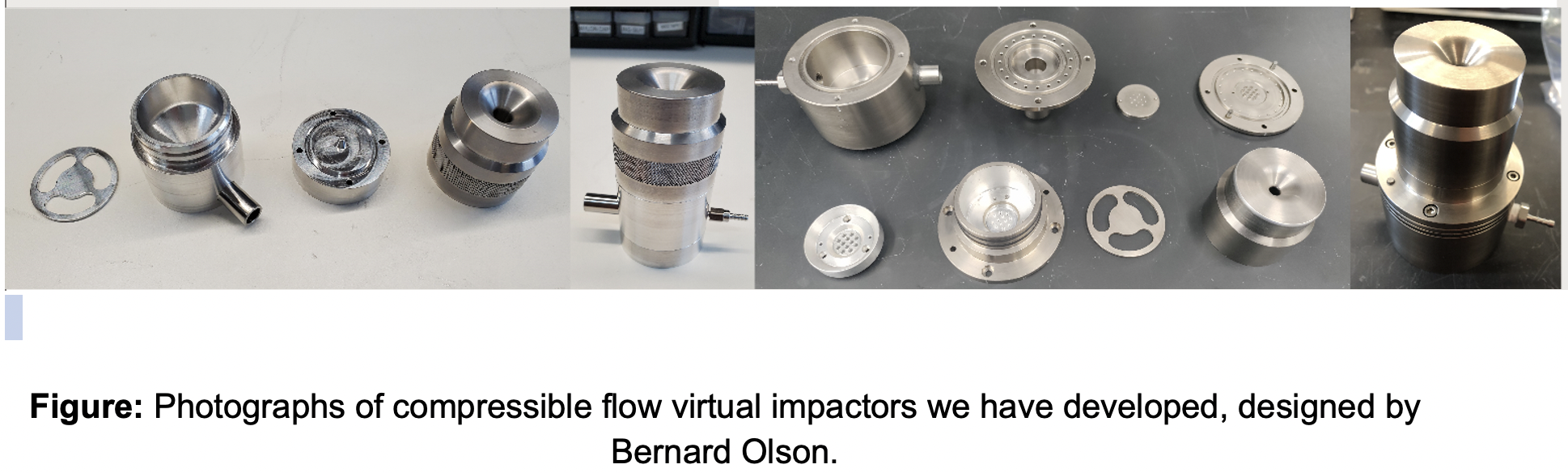
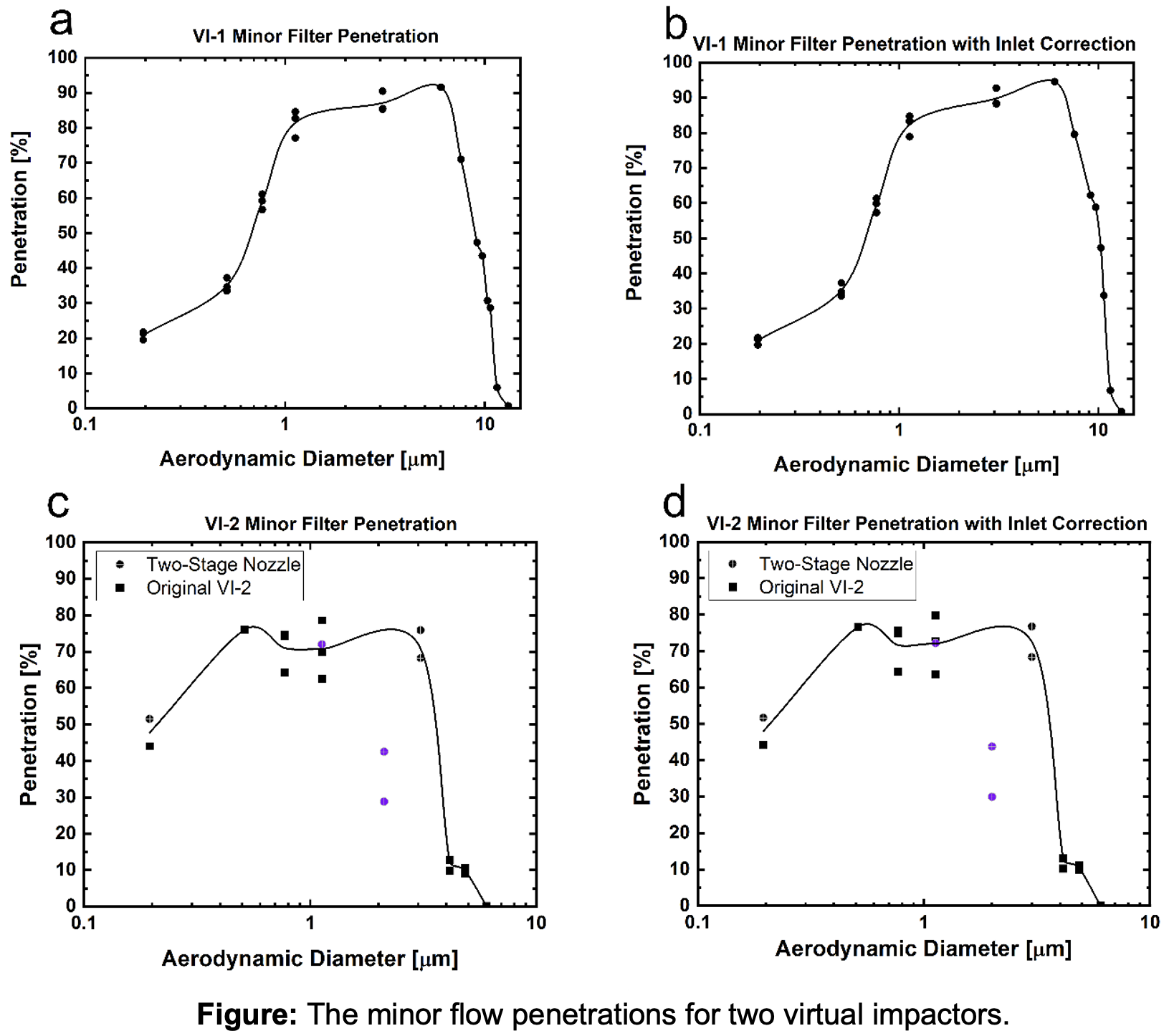
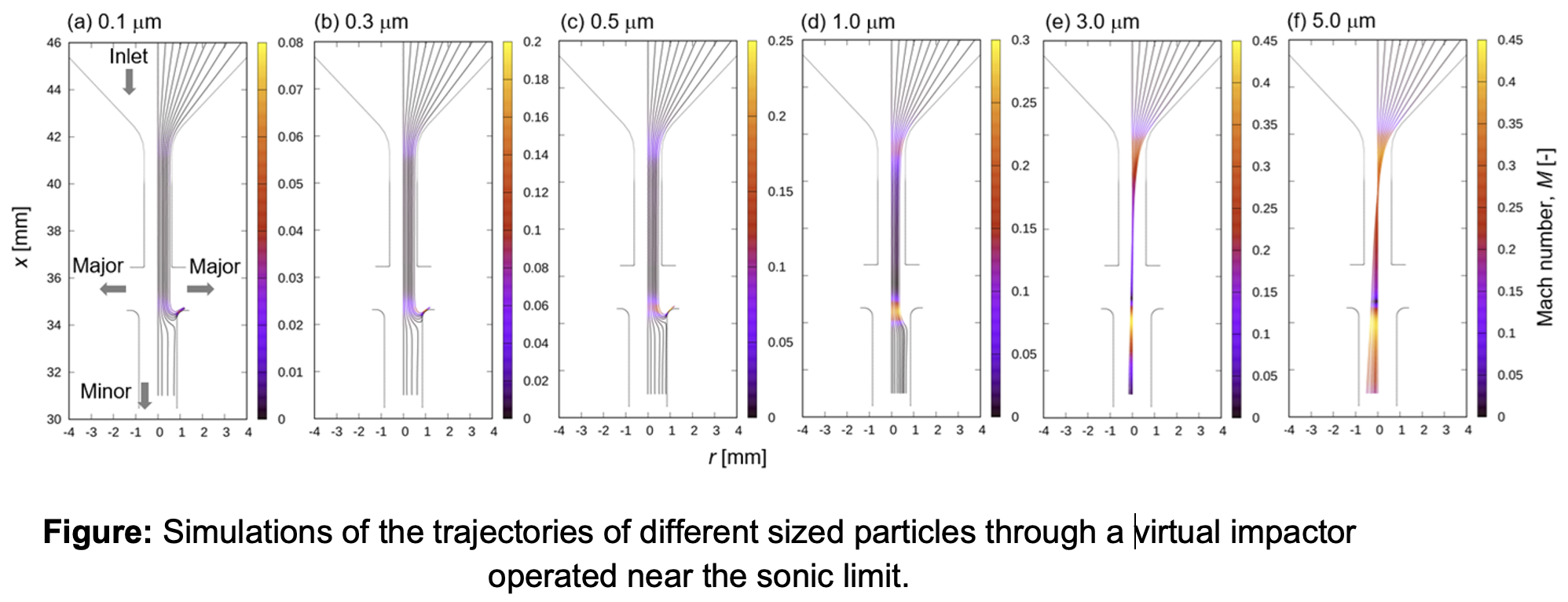
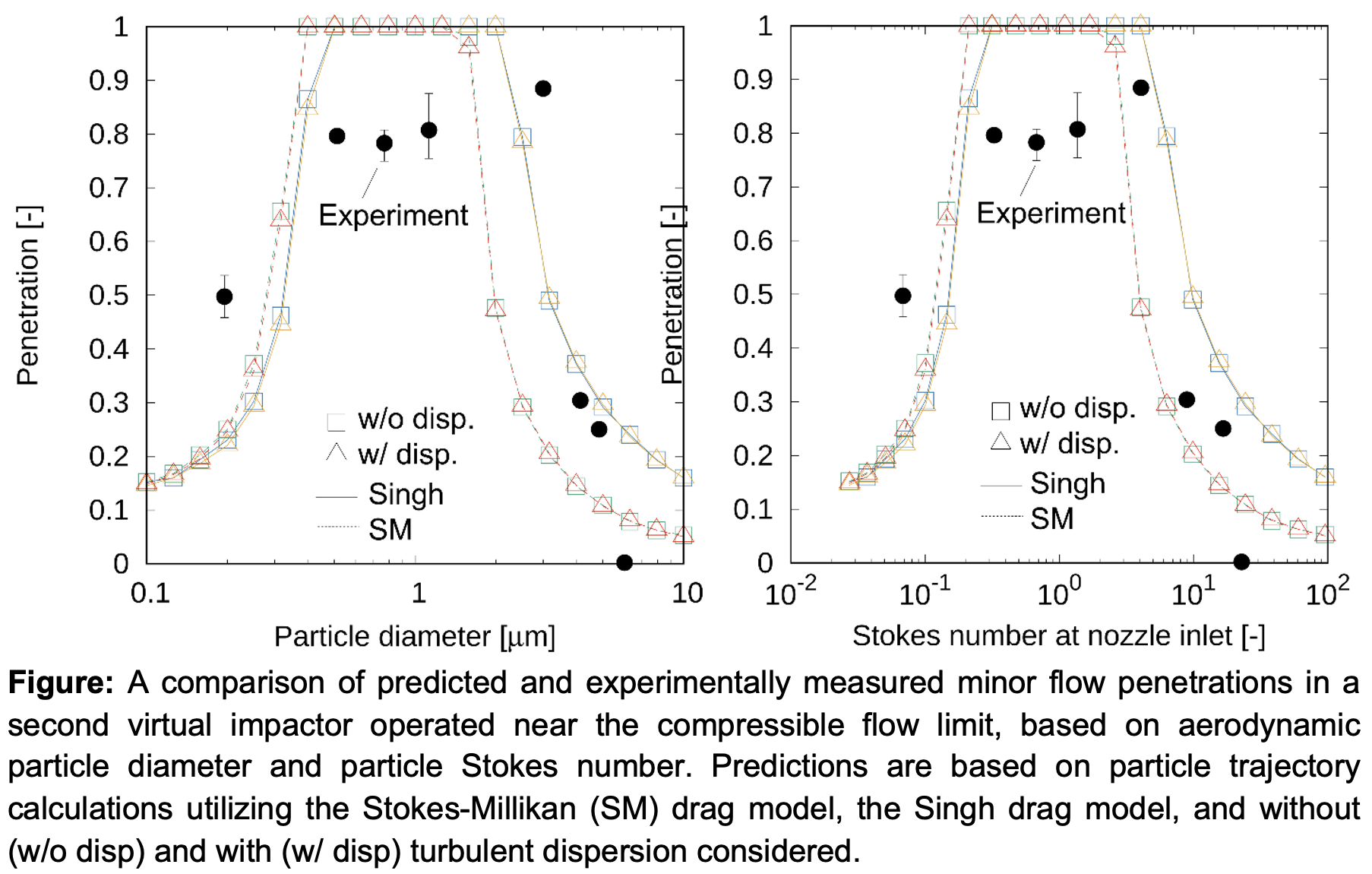
Virtual impactors have been utilized towards classifying and increasing aerosol concentrations in sampling and measurement systems for half a century. Airborne particles are sampled into and accelerated through the nozzle, and directed towards the receiving tube. The majority of this sampled flow is then diverted, typically with streamlines bending more than 90o into a “major flow” passage, while only a small remaining faction of the flow directly passes into the receiving tube (the “minor flow” which is often 10% or less of the total sampled flow). We continue to developed improved virtual impactors for aerosol sampling, pushing into a regime where the flow is compressible. Our goals in such studies are to:
- examine whether submicrometer particle inertial concentration in the minor flow is possible, with atmospheric pressure upstream.
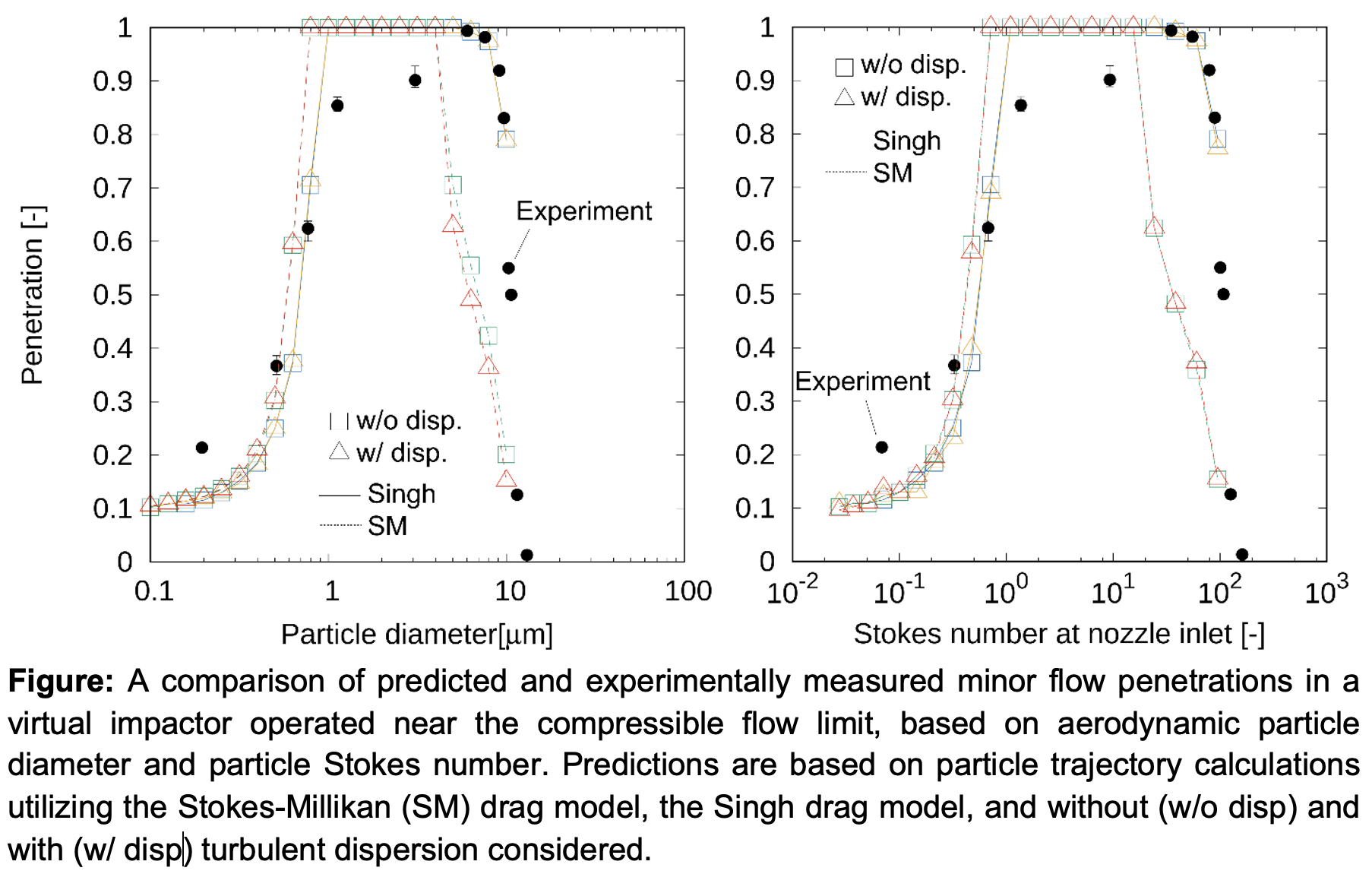
- determine whether theory, accounting for flow compressibility and non-Stokesian drag can correctly predict impactor behavior with “sharp” large particle penetration curves.
- demonstrate near-complete pressure recovery, such that atmospheric pressure instruments can be employed downstream if the sample flow is at ambient pressure.